If you’re reading this, you’re probably asking yourself:
- Am I too late to start learning French?
- How long does it really take to pass TEF Canada?
- And what’s the fastest way to get there?
I get these questions almost every single day.
So in this guide, I’ll show you exactly what I would do if I had to pass TEF Canada in 2026.
No fluff- just 4 practical steps that actually work.
And at the end, I’ll also share some resources you can start using right away.
Step 1 – Understand the 2026 Reality of the Exam
Before anything else, you need to understand what you’re actually preparing for.
For Canadian immigration, the two main exams are still TEF Canada and TCF Canada.
In 2026, TEF Canada is still the most popular option. I personally recommend it over TCF because, for many candidates, the speaking and writing sections feel more structured and easier to approach. I’ve also made a full comparison video—feel free to check it out.
Now here’s the biggest mistake most learners make:
👉 They start learning French without ever looking at the exam format.
Don’t do that.
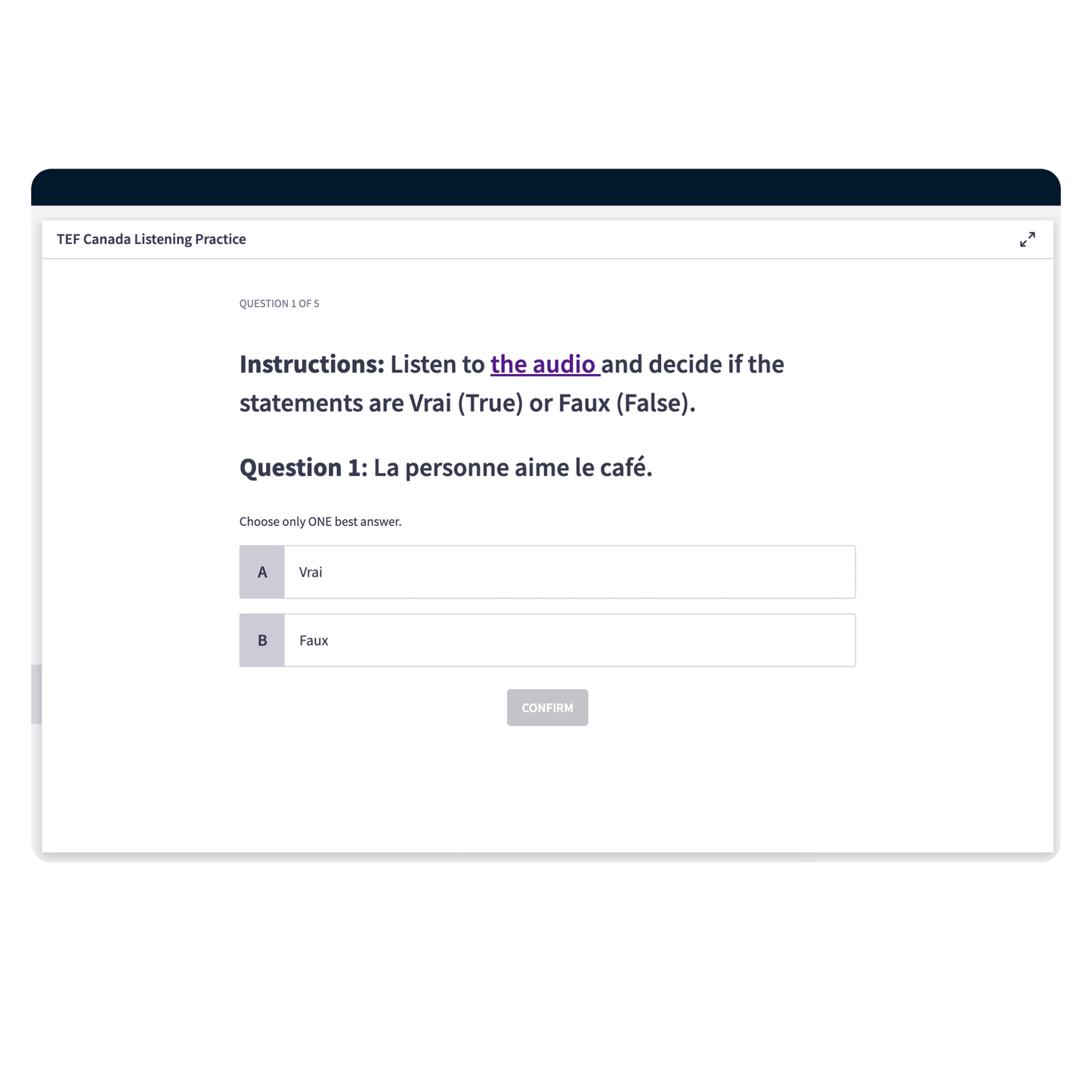
Go to the official website Le français des affaires and explore sample questions. Try listening and reading tasks—even if you don’t understand everything.
Why?
Because you’re not just learning French—you’re training for a test format.
And TEF Canada has 4 sections:
- Listening
- Reading
- Writing
- Speaking
What I see most in 2026 is this:
👉 Students underestimate the speaking section.
You’re expected to respond quickly, organize your ideas, and speak clearly under pressure.
So from day one, don’t ignore speaking practice.
Step 2 – Get Clear on Your Level (and Be Honest)
This is where most people either save months—or waste them.
If I had to start again, I would immediately test my level.
Not guess. Not assume. Actually test it.
Because your strategy depends entirely on where you are right now.
Here’s a rough guide:
- Beginner → around 9–12 months to reach B2 with consistent work
- Intermediate → around 3–6 months
Ask yourself:
- Do I struggle more with understanding or speaking?
- Is grammar holding me back?
- Do I lack vocabulary for real-life situations?

Once you know this, you can build a focused plan instead of doing random lessons.
And this is exactly where many learners get stuck: no structure.
You need a clear progression that builds all your skills while preparing you for TEF Canada specifically—not just a general French course.
I’m launching my TEF Canada course in May, and I’ll leave the link here. Make sure to check it out.
Step 3 – Study Smart (Not Just Hard)
In 2026, the problem is not a lack of resources.
It’s actually the opposite: too many resources, no clear direction.
There’s YouTube, apps, AI tools, podcasts… but without structure, it becomes overwhelming.
So here’s what I would focus on:
Listening
Use platforms like TV5 Monde or Radio-Canada.
Practice with real-life content:
- conversations
- interviews
- news clips
Reading
Read practical, everyday French:
- emails
- advertisements
- short articles
TEF doesn’t test literature—it tests real-world understanding.

Writing
Practice structured responses:
- emails
- opinions
- short arguments
Focus on clarity, not perfection.
You can also use tools like ChatGPT to get feedback or suggestions. It won’t replace a real teacher, but it’s still better than practicing blindly.
Speaking
This is the real game changer.
- Record yourself
- Answer common TEF topics
- Speak out loud every day, even alone
Because here’s the truth:
👉 You don’t improve speaking by thinking. You improve by speaking.
If possible, work with a tutor or join group classes to get feedback.
Step 4 – Stay Consistent (Even When Motivation Drops)
Let’s be honest.
In 2026, motivation is not your advantage—discipline is.
At some point, you will feel stuck.
You will feel like you’re not improving.
That’s completely normal.
What makes the difference is consistency.
One thing I always tell my students:
👉 Don’t rely on motivation—build a routine.

Even 30–60 minutes per day is more powerful than 4 hours once a week.
Also, define your “why.”
Why do you want to pass TEF Canada?
- Permanent residency?
- Better job opportunities?
- A new life in Canada?
Keep that reason visible.
Because that’s what will push you on difficult days.
Conclusion – Your Next Step
If I had to pass TEF Canada in 2026, I wouldn’t overcomplicate things.
I would:
- Understand the exam format early
- Get clear on my level
- Study with a smart strategy
- Stay consistent no matter what
If you follow these steps, you’re already ahead of most candidates.
About the Author

Bonjour, I’m Umut, a certified French teacher based in Toronto, with a PhD in French studies. I’ve helped hundreds of beginners build a strong foundation in French, improve their confidence, and succeed in the TEF/TCF Canada exams for Canadian PR applications.
When I’m not teaching, you’ll find me exploring French films, creating content for my students, or enjoying a café with a good book.