What You Actually Need to Study for TEF Canada CLB 7 (2026 Guide)
If you're preparing for TEF Canada, you've probably asked yourself this question: What exactly do I need to study to get CLB 7?
With so much information available online, it can be difficult to know where to start. Grammar books, vocabulary lists, language-learning apps, YouTube videos… Many students end up studying everything without having a clear direction.
The truth is that you don't need to study everything to reach CLB 7 in TEF Canada. You need to focus on the right skills, build a solid foundation, and follow a structured study plan.
In this guide, we'll cover what you should actually study to reach CLB 7 in 2026, including:
-Grammar and verb tenses
-Vocabulary and common TEF topics
-Listening comprehension
-Speaking skills
-Writing skills
-How to organize your preparation effectively
And most importantly, you'll discover why you don't need perfect French to succeed in TEF Canada.
Prefer watching instead of reading? I've also covered everything in this video, including the grammar, vocabulary, and four skills you should focus on to reach CLB 7 in TEF Canada.
Watch the full guide below!
1. First, Understand What CLB 7 Means
Before you start studying, it's important to understand your goal.
CLB 7 (Canadian Language Benchmark 7), also referred to as NCLC 7 in French, corresponds broadly to an upper-intermediate level of language proficiency.
At this level, you should be able to:
-Communicate in everyday situations.
-Express and explain your opinions.
-Understand the main ideas of conversations and discussions.
-Speak with reasonable fluency.
-Organize your ideas and communicate them clearly.
-One important misconception is that you need to sound like a native French speaker to achieve CLB 7.
That's simply not true.
You aren't expected to speak perfect French. What matters is your ability to communicate effectively, understand information, organize your ideas, and use French in practical situations.
Your preparation should focus on developing these skills rather than trying to master every aspect of the French language.
2. What Grammar Should You Study for TEF Canada?
Let's talk about grammar.
Many students spend months studying advanced grammar rules that they rarely use in everyday communication or during the exam.
For CLB 7, you should prioritize the grammar structures that help you communicate effectively in both speaking and writing.
The Five Essential French Tenses
Start by building a strong understanding of these five tenses:
1) Présent: To talk about everyday activities, habits, facts, and opinions.
2) Passé composé: To describe past experiences and completed actions.
3) Futur simple: To discuss future plans, projects, and possibilities.
4) Imparfait: To describe past habits, situations, and experiences.
5) Conditionnel: To make suggestions, express wishes, and discuss hypothetical situations.
These tenses are particularly useful when you need to describe an experience, explain your plans, give an opinion, or make recommendations.
You should also learn how to:
- Ask questions naturally.
- Use negative structures.
- Build longer sentences.
- Connect different ideas.
-Express cause and consequence.

Don't Forget French Connectors!
Connectors are extremely important for both the speaking and writing sections.
They help you organize your ideas, make your arguments easier to follow, and create more natural responses.
Here are some useful connectors to include in your vocabulary:
| French connector | English meaning |
|---|---|
| Cependant | However |
| Pourtant | Yet / Nevertheless |
| Donc | So / Therefore |
| Puisque | Since / Because |
| Par contre | On the other hand |
| En revanche | By contrast / On the other hand |
| Grâce à | Thanks to |
| À mon avis | In my opinion |
Don't just memorize these expressions. Practice using them in complete sentences when expressing your opinions or explaining your arguments.
3. What Vocabulary Should You Focus On?
You don't need extremely advanced vocabulary to reach CLB 7.
Instead of memorizing random difficult words, focus on practical, everyday French related to common topics.
The TEF Canada exam tests your ability to understand and communicate in different situations. That's why building vocabulary around familiar themes is so important.
Important TEF Canada Vocabulary Topics
Here are some of the main topics you should include in your study plan:
Work and studies: professions, workplace, colleagues, education, and career plans.
Housing and apartments: renting, moving, accommodation, and neighbourhoods.
Transportation: public transportation, driving, traffic, and commuting.
Technology and social media: online communication, digital tools, and social networks.
Health and lifestyle: exercise, nutrition, healthy habits, and well-being.
Environment: pollution, recycling, climate change, and environmental protection.
Shopping and services: stores, purchases, customer service, and complaints.
Travel and vacations: destinations, accommodation, transportation, and activities.
Daily routines: everyday activities, schedules, and personal habits.
Education: schools, courses, learning experiences, and professional training.
For each topic, try to learn four things:
1) Useful vocabulary and expressions.
2) Common verbs and how to use them.
3) Expressions for giving opinions.
4) Vocabulary for discussing advantages and disadvantages.
For example, when studying the topic of transportation, don't just memorize words like le bus, le métro, or la voiture.
Learn how to discuss the advantages and disadvantages of public transportation, explain why you prefer one means of transportation, and suggest ways to improve transportation in your city.
This is the type of vocabulary practice that will help you during the exam.

4. What Should You Study for the TEF Canada Listening Section?
Listening is one of the most challenging sections for many French learners.
A common mistake is trying to understand every single word.
You don't need to understand every word to understand a conversation.
Instead, train yourself to:
-Understand the general situation.
-Identify important details.
-Recognize keywords and expressions.
-Follow conversations at a natural pace.
-Understand the main ideas and purpose of a message.
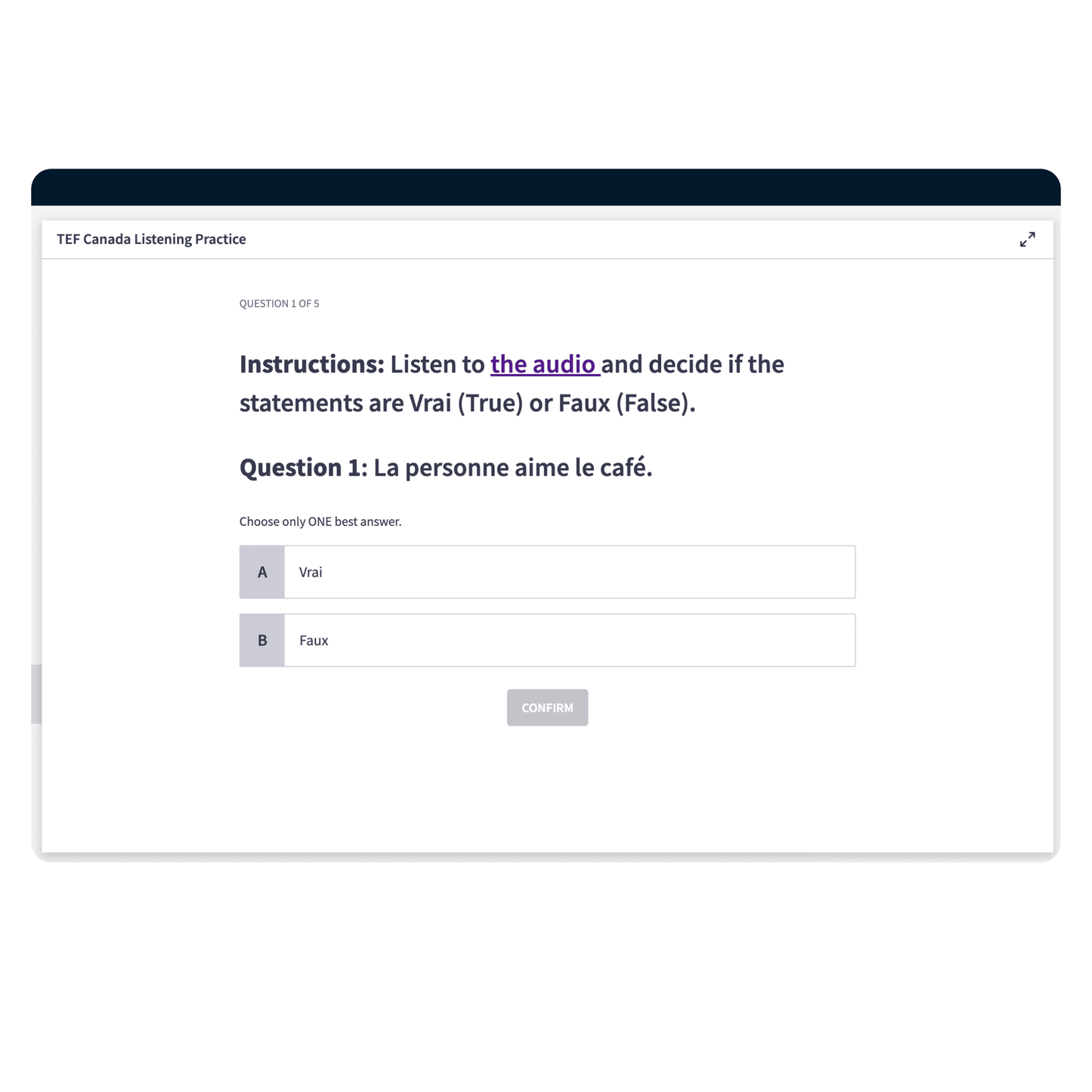
The TEF Canada listening section includes different types of audio recordings, such as conversations, announcements, interviews, and discussions.
Your practice should reflect these different situations.
Where Can You Practise French Listening?
Here are a few resources you can use to improve your listening comprehension:
-Easy French news: Listen to short news reports and practise identifying the main ideas.
-Graded podcasts: Choose podcasts adapted to your current French level.
-TV5MONDE: Explore French listening activities and exercises.
-Radio-Canada: Listen to authentic French Canadian content.
-TEF-style exercises: Practise with exam-like questions to become familiar with the format.
One of the most important things you can do is listen consistently.
Even 15–20 minutes of focused listening practice every day can help you improve over time.
5. What Should You Study for the TEF Canada Speaking Section?
Speaking is often the most difficult section for students.
Why?
Because many people spend a lot of time studying French passively. They read grammar explanations, memorize vocabulary, and watch videos, but they don't actually practise speaking enough.
To reach CLB 7, you need to develop the ability to express your ideas clearly and respond to different situations.
Focus on practising how to:
-Express and explain your opinions.
-Ask questions naturally.
-Compare different ideas or options.
-Give recommendations.
-Justify your point of view.
-Develop arguments and provide examples.
You don't need perfect pronunciation, but you do need clear communication, reasonable fluency, and well-organized responses.
One Simple Exercise to Improve Your Speaking
One of the best things you can do is record yourself speaking French.
Choose a familiar topic and speak about it for a few minutes. Then listen to your recording and identify areas where you can improve.
Pay attention to:
-Pronunciation mistakes.
-Grammar errors.
-Long pauses and hesitation.
-Repeated vocabulary.
-Difficulty organizing your ideas.
You can repeat the same exercise regularly and compare your recordings to track your progress.
The goal is to become more comfortable expressing yourself in French without constantly translating everything from English.

6. What Should You Study for the TEF Canada Writing Section?
For writing, one of the most important things to focus on is structure.
Many students know enough vocabulary and grammar to express their ideas, but they lose clarity because their writing is disorganized.
You need to practise different types of writing and learn how to organize your responses.
Focus on:
Emails.
Opinion texts.
Formal requests.
Short arguments.
You should also practise how to:
1) Introduce your topic or idea.
2) Explain your point of view.
3) Develop your arguments.
4) Give relevant examples.
5) Justify your opinions.
6) Connect your ideas using appropriate connectors.
Remember that connectors are just as important in writing as they are in speaking.
Expressions such as tout d'abord, ensuite, de plus, cependant, par conséquent, and pour conclure can help you structure your writing and make your arguments easier to follow.
Don't focus only on writing longer texts. Focus on writing clearly, logically, and accurately while respecting the requirements of each task.
7. The Most Important Thing: Consistency
If there's one thing I want you to remember from this guide, it's this: consistency makes a huge difference in your TEF Canada preparation.
The biggest difference between students who make progress and those who struggle is often not talent or intelligence. It's the consistency of their preparation.
Think about the difference between these two study habits:
Studying 30 minutes every day.
Studying for five hours once a week.
Regular practice helps you build habits, remember what you've learned, and gradually improve your French skills.
You don't need to spend several hours studying every day. What you need is a realistic routine that you can maintain over time.
Try to include different skills in your weekly preparation:
Grammar practice.
Vocabulary building.
Listening exercises.
Speaking activities.
Writing practice.
Most importantly, don't spend all your time on grammar or vocabulary while ignoring the other sections of the exam.
TEF Canada preparation is about developing all four language skills.

Conclusion: What Do You Actually Need to Study to Reach CLB 7?
Let's recap.
If your goal is to reach CLB 7 in TEF Canada in 2026, focus on these six areas:
Practical grammar: Master the essential tenses and sentence structures.
Everyday vocabulary: Learn useful expressions related to common topics.
Listening comprehension: Practise understanding conversations and identifying key information.
Speaking: Develop fluency, express opinions, and organize your ideas.
Structured writing: Learn how to write clearly and develop arguments.
Common TEF topics: Build vocabulary and practise discussing different everyday situations.
And remember: you do not need perfect French to reach CLB 7. You need clear, practical communication and the right preparation strategy.
Don't waste your time trying to study everything. Focus on what matters, practise consistently, and make sure your preparation reflects the actual requirements of the exam.
Good luck with your TEF Canada preparation!
At Tumu Learning, we help French learners in Canada build their skills and prepare for TEF Canada and TCF Canada with structured lessons, practical exercises, and personalized guidance.
Discover our French courses and start working towards your language goals!